I will tell you about stories, and this one starts in an organic farm in Hamburg. Yellow flowers, natural wine, music from plants, and two hosts introducing 10 strangers through the stories that connected them. By the end of the night, we're talking like old friends.
No, this is not a story of a blind date, or a quirky happening. This was Product at Heart's leadership event.
Because there is one thing that Arne and Petra do so much better than anyone else: they curate connections that open the human to human conversations that we are so craving. The stories that make us feel that we are less alone as (product) people, the one who make us think, and the ones who will carry with us for much longer than the conference time.
And stories, to me, became the thread that tied everything together.
Here are the three that stuck with me.
Where do your future stories come from?
The event, shaped for a selected group of product leaders, started with an important backdrop: product leadership in the era of AI, is still product leadership. And as much as the new tech is influencing our jobs, and our products, much of what made great (product) leaders, is still the same.
That is all true, and at the same time, no day passes without a lot of questions about the future: what will LLM do? How will my job look like? Which skills will be important? What kind of experiences will we seek?
I ask myself these questions, sometimes a bit too often, but if I have to be honest, I never really stopped and thought about one thing: where do these ideas about the future come from?
Until I heard Johannes Kleske's talk about the future. He is a critical futurist, and what he presented was a framework to think about decisions.
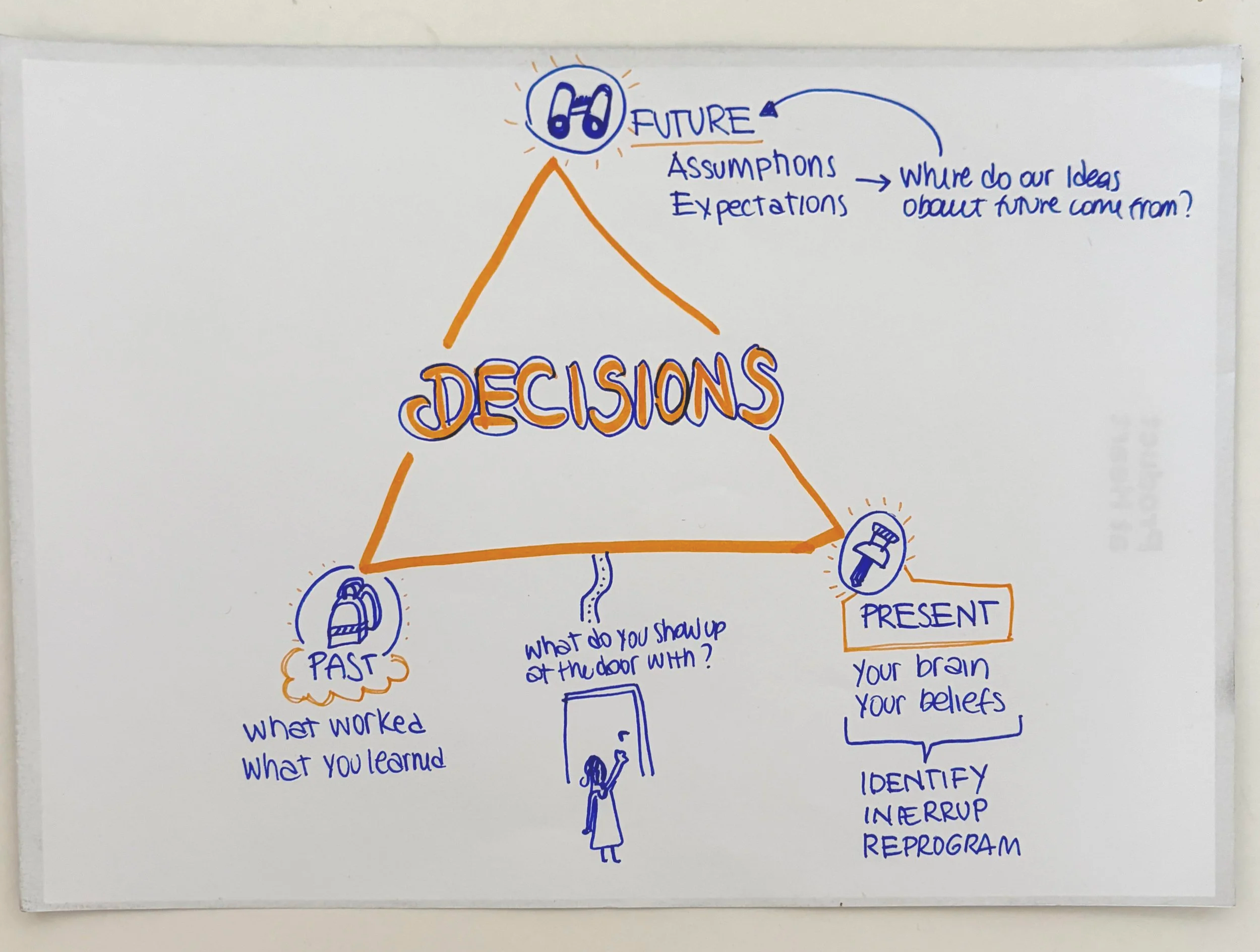
Each decision is created in a balance of 3 forces:
the weight of the past: things that we have done and shape our definition of right/wrong
the push of the present: all that needs attention here and now
the pull of the future: what you expect to happen
And here comes the interesting part: the pull of the future is what influences much of our decisions, but we hardly reflect where those assumptions and expectations come from.
If we believe there is a future where AI will take our jobs, where does that story come from? Is it popular culture (hello sci-fi)? Tech company marketing? Someone else's business model packaged as inevitability?
If we really stop and think about the future we envision, and surface the stories behind it, we'll unveil quite a lot about ourselves, and our present, but not that much about the future.
The penny dropped there for me.
What if we started to surface those beliefs and dissect where those stories come from? I believe we could learn quite a lot about the future we are pulled towards. If it is a future that we choose for ourselves, or if we are playing in someone else's future.
And from the future to the present...
The story of a paper cup, a crystal glass, and the steel bottle
"Your mind is a puppy, if you do not train it, it will shit everywhere"
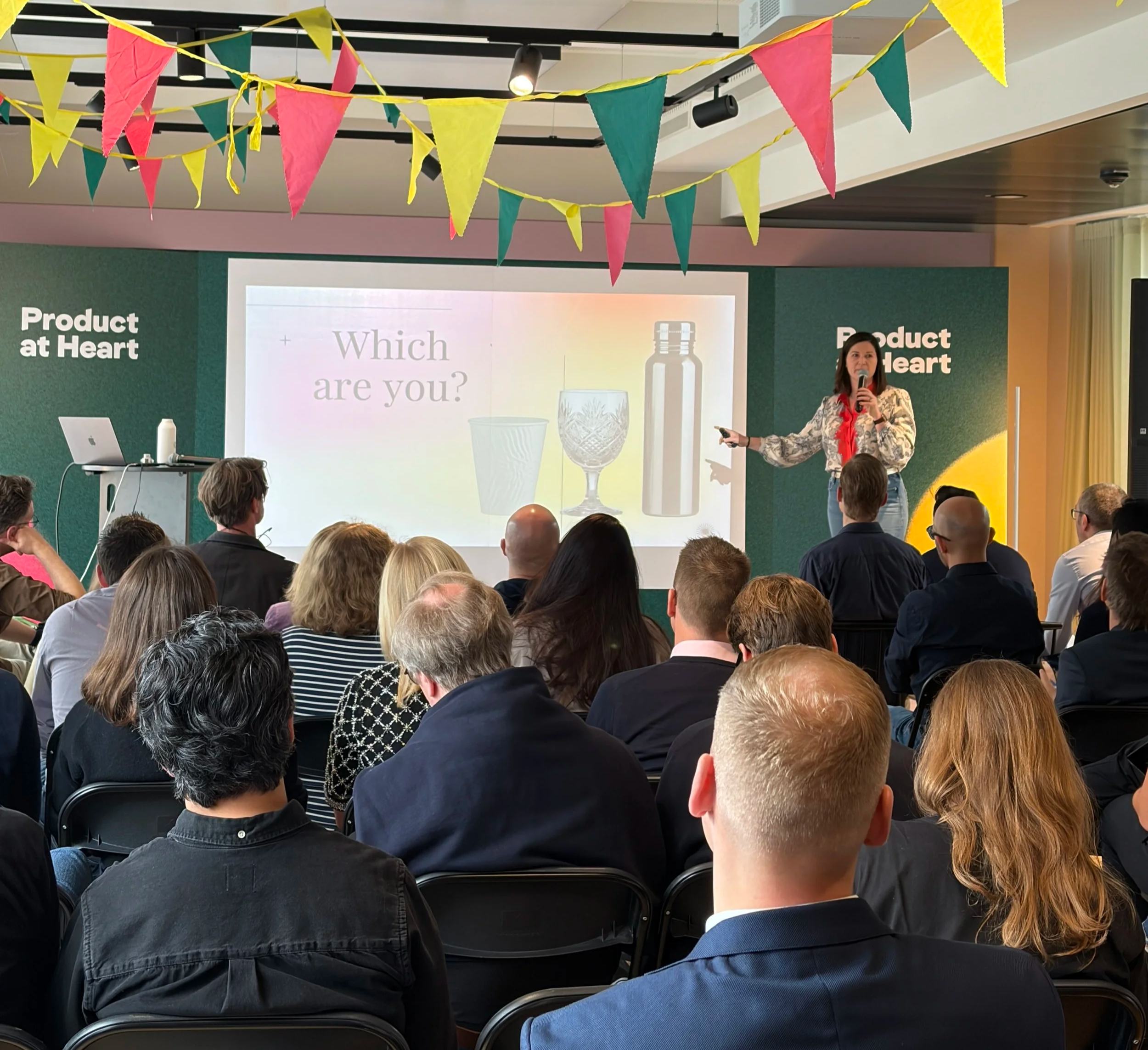
That is the quote that Pippa Topp brought on stage to talk about self-belief and the importance of being really aware of the stories we tell ourselves, and how they influence our view of our abilities.
What I take with me from her talk is that trying to sustain a leadership position without a solid base of self belief, is gonna be too expensive. The metaphor that she used really resonated with me, it is a story of a paper cup, a crystal glass, and a steel bottle.
The paper cup can take some pressure, but it bends, it stretches, it is always on the edge of leaking water. This is leadership that needs reassurance, and is terrified of making the wrong call.
The crystal glass can hold some pressure, but it is still fragile. If you drop it, it shatters into pieces. It is leadership that seeks external validation.
And then there is the steel bottle. Where the boundaries are in control, if you drop it scratches, but doesn't break. It is leadership that validate itself. Can learn, adapt, and grow with whatever is thrown at it. It is leadership with self belief.
What I think is really interesting is to reflect about those 3 "states", because even if you have reached the steel bottle, it doesn't mean that you cannot go back to paper cup.
I definitely have my paper cup moments: when I start something new, when relationships are not established, when I say more yes than I ought to. But the difference is that if you know what the steel bottle is and feel like, you can bounce back to it by recognizing the behavior, stop, and reprogram it.
To me it could look like this: I sometimes catch myself doubting my skills. I compare myself to others, wonder if I am good enough, if I am really living up to expectations.
I spiral, and then I stop, because I have now learned to recognize the pattern. It is part of my constant strive for learning and development, and it is both my biggest strength and biggest weakness.
I learned to tame it by adding a "yet" to the sentences that spin in my head.
"I do not know this...yet"
I see it. I stop, I course correct and start learning.
This happens on my best days. My worst days, oh well...I have to accept to be the paper cup.
Stop showing up with your stories already written
One of the biggest mistakes leaders make? Showing up with their story already written.
We walk into meetings with the solution decided, the narrative formed, the outcome we're pushing for. Then we wonder why our teams don't feel ownership, why alignment is so hard, why collaboration feels like pulling teeth.
At Product at Heart, I did an improv workshop with Dr. Chris Heimann, who trains Oscar-winning actors. And one exercise made this pattern, and its consequences, so clear and impossible to ignore.
In pairs, we improvised: one person rings a doorbell and announces who they are. The other opens the door and says, "Hi! You're so welcome, I really needed you because..." and the scene unfolds from there.
First attempt: Most of us chose a profession in advance (I was a shaman). It felt safer, I had something to hang the story on. But the scenes were clunky. Each person was trying to force their pre-formed idea onto the other.
Second attempt: Chris challenged us to leave it open. Don't decide who you are until the last possible moment. See what emerges.
It was hard. Really, really hard to kick away from my head all the ideas and the stories that kept showing up. But I managed and, wow, what a difference.
The scenes flowed, the interactions became easier. Why? Because I wasn't trying to sell my story that I had already played out in my head, we were building one together.
And if you are thinking, what does have to do with product, or business?
Think about this: if that door was the one of a strategy meeting, how many breakthroughs are we missing because the CPO walks in with the roadmap already decided? How many user insights die because the PM has made up its mind on a specific feature to ship?
The best work doesn't come when we think we have all the answers. It comes when we become comfortable with the uncomfortable and are able to leave space for what we didn't plan.
It's about practicing the "yes, and..." , letting go of the control of the outcome, and have the ability to positively react to whatever shows up at your door.
I am sure the ring the door exercise will stay with me for a while.
And even if you are afraid of improv, when you walk into your next meeting, think about this: are you ringing the doorbell as a shaman with all the answers? Or are you leaving space for what you can't see yet?
Make the invisible stories, yours
The stories you believe about the future. The stories you tell yourself about your worth. The stories you force on others instead of building together.
These aren't abstract, they're the invisible pull towards every decision you make, every team you build, every strategy you set.
The challenge is to make them visible, then question them, and choose them intentionally.
Start with one: What's a decision you're about to make? What story are you telling yourself about what will happen? Where did that story come from?
We become the stories we tell ourselves. Make sure they're yours.

How do you make good decisions when you do not have all the facts? My takeaways and reflections from Annie Duke's Thinking in Bets.