Why even smart people need to be told what to do (sometimes)
Everyone says don't hire smart people just to tell them what to do.
Well, I'm not so sure, and I think this mentality is creating a generation of leaders who abandon their people at exactly the wrong time in the name of avoiding micromanagement.
I understand the frustration behind it, nobody wants to be micromanaged. And no, I'm not making the case for it.
But we've overcorrected, and now we're leaving people drowning in autonomy when what they actually need is clear direction.
I believe the heart of the question is simple and quite intuitive: even the smartest people don't know best all the time. In fact, if you think about it, quite often the opposite happens. Because the smartest people are the ones most likely to put themselves into completely new situations: new roles, new industries, new challenges. And in those moments, they're starting from zero whether their ego likes to admit it or not.
The Steering vs. Coaching framework
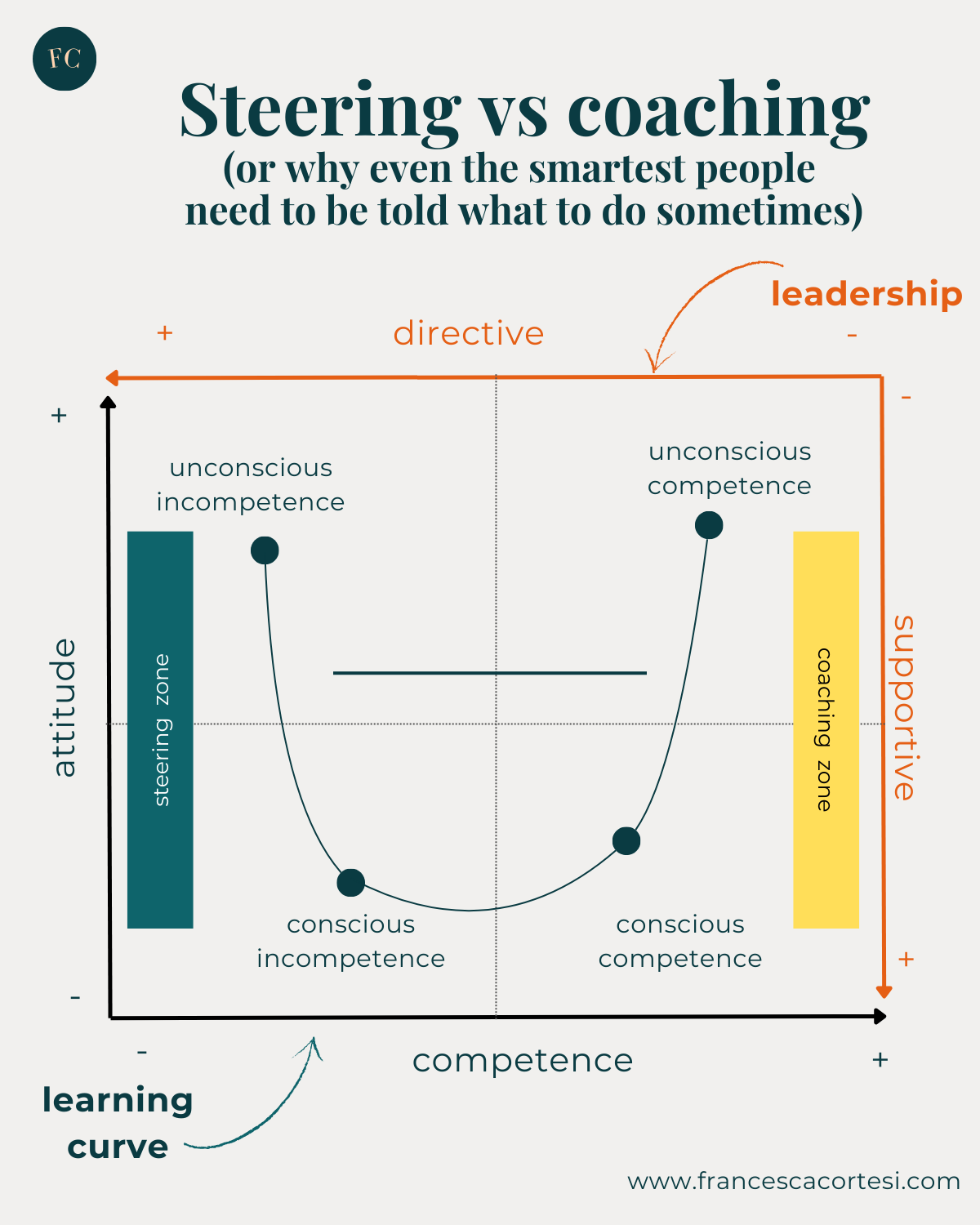
Some years ago I was at a leadership course where they introduced a simple matrix to get a pulse on when people need different types of support. It's built on two axes: competence (how skilled you are) and attitude (your confidence and motivation), and depending on the mapping, you can adjust your leadership between coaching or steering.
A little more background:
The steering zone
Unconscious Incompetence:
You don't know what you don't know. You're new to the role, the domain, or the situation. This is where directive leadership isn't micromanagement, it's the biggest help you can get. You need someone to tell you what to do, what good looks like, and what the pitfalls are. Without it, you're just learning by doing, and I can assure you, it will take (too much) time.Conscious Incompetence:
You're aware of your gaps. You're learning, asking questions, making mistakes. You still need direction, but now you can start to participate in the how.
The coaching zone
Conscious Competence:
You know what to do, but it still takes effort. You don't need to be told what to do anymore, you need someone to help you see your blind spots, refine your approach, and unlock the next level.Unconscious Competence:
You're operating on instinct, you know what to do almost without thinking about it. Here, coaching helps you understand that you're ready for the next step.
The problem? Most leaders only feel comfortable in the coaching zone.
They hire smart people and immediately jump to "I trust you to figure it out." But if that person is in the steering zone, even if they're brilliant, you've just set them up to fail slowly and painfully.
I can definitely see myself in this, on both sides of the playing field.
As an employee, I thought asking for help when starting a new role was a sign of weakness. "They hired me, so I can figure it out" was the mantra in my head. I had a boss who supported me but was never really clear on the skills I would need to take my next career step. They kept telling me "you don't know what you don't know”. I banged my head on that sentence for years. I just felt frustrated, and what I realize now is that what I actually needed was a framework. Point at my blind spots, but also give me a blueprint on how to tackle it. Then let me run with it.
Instead, I spent years learning the hard way when I could have learned the fast way.
I do not blame that boss, as a manager I made exactly the same mistake.
I was terrified of being perceived as a micromanager, and it took me quite some time before I recognized that sometimes the best way to help someone is to give them the blueprint and tell them what to do.
The real skill: knowing when to ask
It's a lesson I learned the hard way, but I do see how there is a lot of value in being vulnerable and asking for direction, and how asking for help is a true superpower. And as a leader, I try to understand the context and adjust my approach accordingly.
The biggest shift is not defaulting to one style, but being aware of my personal preference without assuming it's the same for others. Coach when people need coaching. Steer when they need clear direction.
So yes, hire smart people. Then do the hard work of reading where they actually are, not where you assume they are. Steer when they're learning. Coach when they're competent. And make it safe to say "I don't know" without having to wait until they're drowning.
We keep assuming that an AI-future is inevitable. And yet, I spent a whole summer without it, and I did not miss it a bit. That made me think about: which problem are we actually solving?