Follow the incentives, and find where your organizational friction really comes from
I once spent months trying to get a go-to-market machine running at full force. The product was ready, the strategy was clear, and yet there was constant friction with the sales team, frustration on both sides, things not moving despite everyone's best efforts.
I pushed harder, I got frustrated, I called for meetings, I communicated my point of view. All with no result other than my frustration rising. Then I realized that the sales team was incentivized to push for a completely different product line than the one we were investing in from the product side. And sales leadership didn't buy into the product focus.
No amount of talk or alignment meetings would have fixed that. No happy ending here, I flagged the issue, but a true alignment was never reached.
I was for sure frustrated, but I learned the lesson: the incentives were misaligned, and incentives always win.
The same insight came back during a board education I took recently and made me reflect on something that should be obvious but often isn't: the owners of a company, represented by the board, dictate how the company operates. Their vision, their timeframe, their way of reasoning around growth or costs set the frame for everything else. Yet far too often, the owners' perspective isn't properly represented in the strategy, and therefore frustration follows.
When thinking about organizational friction through incentives lenses, I started to see patterns:
Product and sales pulling in different directions, one driven by OKRs and the other by sales quotas.
Leaders planting long-term seeds when the owners want an exit in 15 months.
Rewards and promotions tied to completely different timeframes across teams.
Management wanting employees to dare, with no meaningful reward for doing so.
In product, we often talk about clarity and focus, and if you ask me the first step is understanding incentives, where they come from, and how they cascade.
It starts at the top, with owners or shareholders, and trickles down to the thousands of choices made by everyone in the company every day. What is the timeframe? What is the most important thing to optimize for? How are rewards distributed?
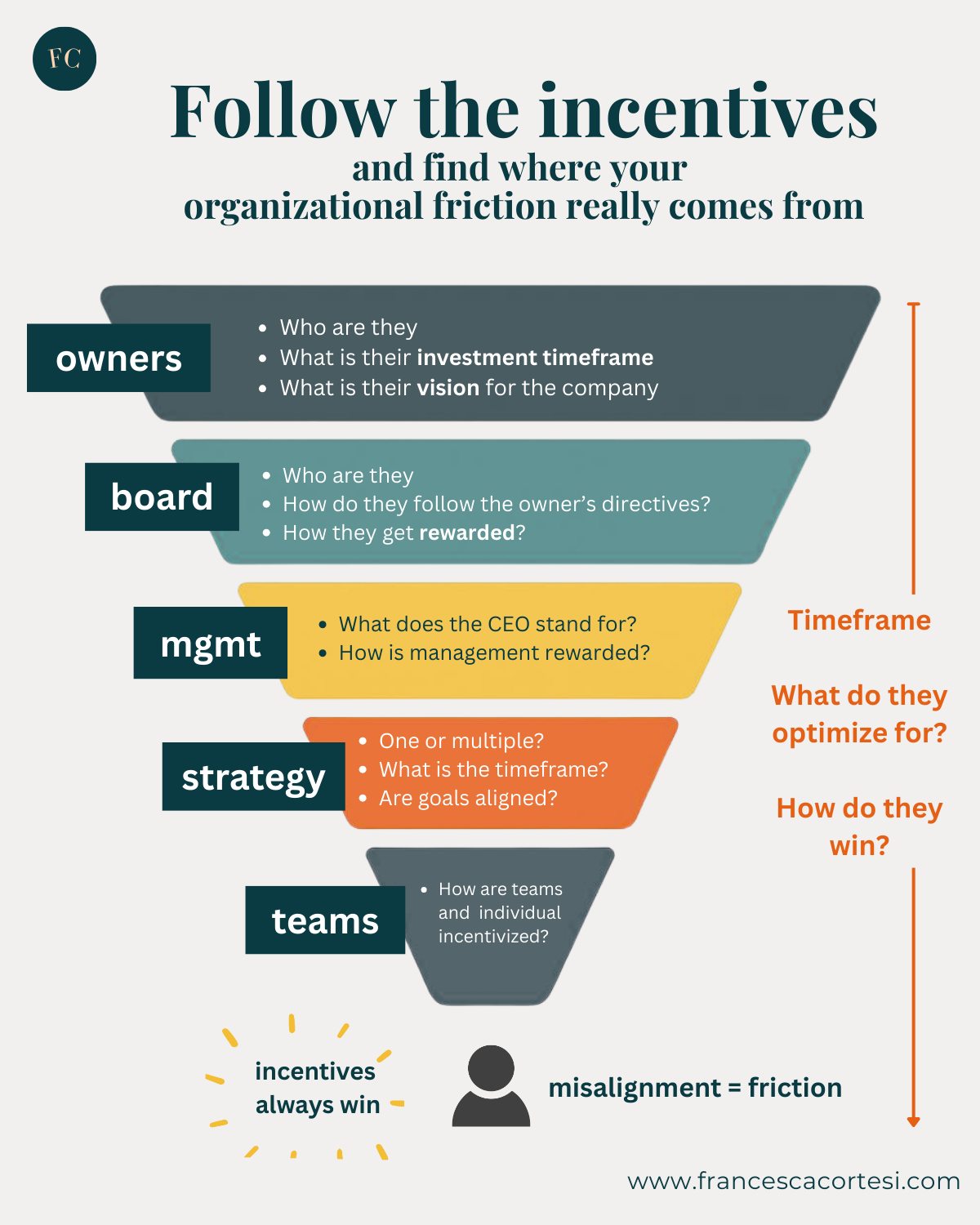
And often the misalignment of incentives has clear signs: friction, control rising, and frustration for things not going in the "right" direction despite your best efforts. If you sense them, dig deeper.
Here is how I did it with another concrete example.
I was leading a product strategy that tried to move multiple business metrics at once. Teams were pushing many initiatives in parallel, making progress across the board. The constant feedback from the board was that we weren't moving fast enough. I got frustrated, then I went deeper. The real issue was that for the owners, moving one specific metric faster mattered far more than incremental progress everywhere.
Once I understood that, I pivoted to a more focused strategy, aligned our work with what actually mattered, and things started to flow.
You might disagree with what you find. You might make the case for a different direction. But following the incentives will give you a clear look at the boundaries you are operating within.
Can you name the incentives at play in your org?
We keep assuming that an AI-future is inevitable. And yet, I spent a whole summer without it, and I did not miss it a bit. That made me think about: which problem are we actually solving?