My main takeaways from Thinking in bets: making better decisions under uncertainty
Have you ever heard the saying "life is like chess"?
I have, plenty of time, and yet I keep on thinking: is life really like chess?
In chess you know all the pieces, they are always visible, and there are really specific rules on the play. You can control the game, and predict it, so much so that it has been one of the first fields where computers outsmarted men.
But life, oh well, life is not always so predictable.
Unforeseen circumstances arise, new pawns (or players) enter the room, luck plays a role (sometimes huge), and if we are trying to navigate it all thinking the playing field is "fixed" we are probably gonna end up disappointed.
I am more and more convinced that life is less like chess, more like poker.
Poker is about handling the uncertainty of not knowing all the moves, preparing for the bluff, hoping for luck, and handling the unforeseen turns the best we can.
I am not a poker player, and yet I make important decisions in a ever-changing playing field for work. And it is precisely to get better at it that I decided to read "Thinking in bets, making better decisions when you do not have all the facts" by Annie Duke. Who better than a former poker champion that has studied decision-making for all her life to help me the journey?
In the book Annie Duke presents her way to navigate decisions in uncertainty. Starting from recognizing that decision outcomes have nothing to do with decision quality, admitting that luck is as important as skills, and helping us identifying tactics to make better call and reinforce positive decision-making behaviors.
If you read the above it might sound straight forward: separate results from decisions, luck from skill, and double down on where skills play a role. But, to get there we need to let go of hardwired beliefs, that sometimes we do not even know exist.
If I got you curious, but you are not yet sure if reading the book is a good investment, here are my main takeaways.
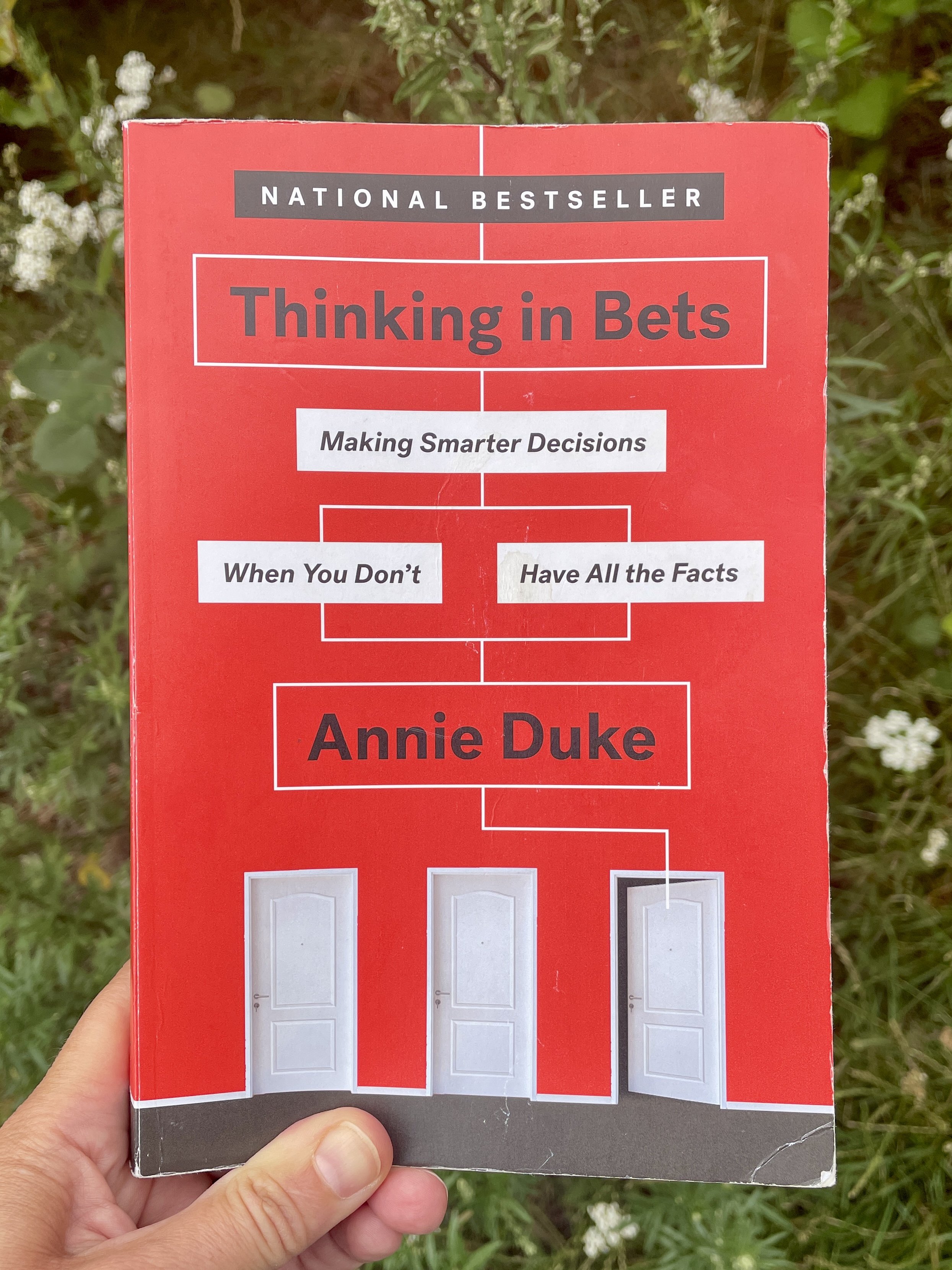
1-The quality of your decision has nothing to do with its results.
The book opens with introducing the concept of "resulting" which is the tendency of associating the result of the decision with the quality of it. Good result = good decision. Bad result = bad decision.
To make this more concrete think about the best decision you've ever taken.
Was it connected with a good outcome?
Most likely your answer is yes, and this creates the first decision-making challenge.
The reason why we believe that the best decision are the ones that result in good outcome is because we tend to interpret the world from a right/wrong point of view. Let's take the weather forecast as an example: there is a prediction that tomorrow will be sunny, and then it rains. Our immediate reaction is to think the prediction was wrong, but any prediction that is not 0% or 100% cannot be wrong only because the most likely scenario doesn't happen (or the other way around).
Being right, or being wrong is connected with a feeling, and oooh we feel so good when we "got it right", and we go back and anguish more than we ought to when we were "wrong". We are attracted to these feelings, and to be good at decision making under uncertainty we need to let go of all of them. A decision can still be good, even when an unlikely scenario unfolds and the result is not what we expected.
This is why all decisions are bets: they involve choices, probabilities, risks, beliefs. The art is in dividing decision from result, and understanding what is the role of luck in the outcome.
2-Is skill or luck the reason of your good outcome?
Our brain is wired to find patterns, and then use them as they were strict rules. We are not comfortable with not controlling, and not knowing. And yet, there is a joker always there, playing us: luck.
The sooner we recognise that luck plays a role in all our decisions and outcomes, and we can divide luck from skill, reinforce the decisions based on skills and let go of the ones based on luck, the better off we'll be at making decisions.
Muuuuuuch easier said than done.
Accepting that luck can be what determines an outcome means accepting there are things we can't control, no matter the level of our skills and planning. And it can be extremely challenging to accept. But it is in focusing on learning that we find our way at improving our decisions.
Every learning loop starts the same way: belief -> bet -> outcome
The key is to understand if luck or skill influenced the outcome, and reinforce our belief only if a skill was involved.
I know what you are thinking, dividing between skill and luck is (again) oh so hard. And to understand why we need to go back to psychology and evolution. There are some patterns that are worth noting:
We have a tendency to take the credit for good outcome, and blame luck for the bad ones. This is called self-serving bias and it is deeply embedded in how we think, which means we have to fight it intentionally. One way of doing it is by learning from others, but..
We evolved to compete and tend to blame others for the bad results and fail to give them credit for the good ones. The comparison trap is real, and psychologists have proved over and over again that we would rather put ourselves in a bad overall position but soar above most everyone else, than be in the middle.
Yes, to make better decisions we need to “fight” the system. The point is in realizing it and be intentional in reshaping our habit of mind, and our beliefs to get to a more objective view of the world.
3- Be intentional in calibrating your beliefs
Every bet/decision we take is based on luck, and skills, and behind every skill there are experiences and beliefs. The better we become at understanding and adjusting our beliefs, the better the foundation for our bets will be. We just have to be extremely aware that we have centuries of evolutions fighting against us, again…
How we form beliefs is in fact shaped by the evolutionary push toward efficiency rather than accuracy, which in short means we tend to believe what we hear and rarely take the time to double-check it. And we also tend to bend information to confirm and protect our beliefs. At this pint you might be thinking: omg, we are doomed. And in a way we are, if we are not intentional about it.
The whole book makes the point that framing beliefs as bets can help us in the quest of truth-seeking: bets are by design nothing completely true or false, and they can help nuance our approach as we do not enter the conversation trying to prove a point. The author gives also different tactics on how to be better at calibrating beliefs and creating a truth-seeking experience
acknowledge that we do not have all the answers
create a group that exposes us and encourage different view points
be aware that we are biased toward the messenger as much as the message
In the business context I would also add another important component: pairing your beliefs to assumptions, and start creating insights to validate (or invalidate) them. Starting from assumption validation, challenging our viewpoint of the world, has always been important, but it become fundamental as the pace of AI development keep on shifting the landscape around us.
One example: only some months ago there was a belief that marketplaces will become irrelevant because they will be perceived as a “middle man” by the majority pf people starting their search journey somewhere else. As a consequence many marketplaces placed a bet on a new type of search behaviour, based on natural language search. So did the marketplace I work for as well.
We placed a bet based on a belief, and by testing we discovered that the belief was not accurate.
What we discovered is that the new type of search didn't deliver a better experience, the complexity in the data couldn't get to the extreme personalisation we were envisioning, and the user habits are hard to change (especially when a fundamentally better experience is not there). So the assumption was not true, and the belief shifted from "the whole search behaviour will be disrupted" to "there is a potential to apply the technology to serve different parts of the funnel".
This seems a straight forward and logic step, but it took some work on the positioning of how we decide where to invest (to scale or to learn), how to view that investment (failure or learning), and how to take the next step.
Being able to think in bets requires a structure and a mindset that is different from one that always expect good results from investments, and falls into the trap of resulting.
4- Concrete tips for better decision accuracy
You might have read so far and think: ok we get it, we are not wired for good decision making, the system and our biology is fighting against us, but how do we take the step outside the matrix?
One good news is that being aware is half of the job, the second good news is that Annie Duke lines up many concrete strategy to fight beliefs bias, resulting, and move toward more accuracy.
Her tips are anchored in 3 concepts:
1- Focus on accuracy over confirmation, meaning rewarding truthseeking, objectivity and open-mindness
2- accountability for the quality of the decisions not the result
3- openness to diverse ideas
She goes on and explains how you can achieve it by having a small group that is focused on that, systems like role-play, explicit calling out bets and level of bets in your strategy process, and making space for skeptical voices.
One part I thought was specifically interesting was the one about incomplete informations. As much as we have a tendency to bend information to fit our own beliefs, we have a tendency of seeking data that confirms a certain story or narrative, and this becomes a problem if what we are optimizing for is accuracy. Especially in corporate we tend to reward what helps us establish a certain truth or view of the future, and the dissenting voices are either discarded, or they do not dare to speak up. But what if the system was built instead on providing the most accurate, objective, evolving viewpoint instead? That is the biggest gap I see between the tactics described and the reality.
This part was the one that felt the most familiar to me, as I am used to work with many of the tactics the author describes. What I was lacking in the narrative is a mention of the culture that is needed to operate this way.
In my experience all of these tips require a culture that accepts uncertainty, different views, and builds the whole system around learnings, not set "right/wrong" beliefs. And that is not something that is easy to find.
The big questions are:
How do we present bets, and edge bets when the pressure is on immediate results?
How do we create a culture where new beliefs are encouraged and not treated as a failure?
Why does it all matter: bringing bets into your strategy work
I started to read this book in the middle of a strategy process. I have done many of these, and uncertainty has always played a role, but never like this year I felt that we (and everyone with us) are quite literally betting, and sometimes big chips, on a future that keeps on changing.
Technology is evolving, some behaviors are changing but we do not know which ones will stick, the geopolitical situation is getting more and more unstable. The only constant is change, but how do we choose?
Doubling down on learnings, dividing decisions from results, and more importantly thinking in scenarios and daring to put a "certainty/bet level" on every scenario is the only way to navigate this. Yes, and there is something more.
The part of the book that especially stayed with me, was the one about the importance of not over-indexing your decisions based on the present.
We are biased towards the now, and the version of the future that we see in front of us therefore our decisions ofter over index to optimize for the present, not for the past, or the future. But if we can insert a moment to stop and think before deciding, we can analyze the decision from different lenses perspectives:
what will be the consequences of my decision in 10 minutes, 10 months 10 years?
how would I feel if I made the decision 10 min ago, 10 months ago, 10 years ago?
If we can analyze different perspectives, from different point of views, with accuracy and bet level in mind, we will be much better off. The challenge is that we often react to the moment, and do what poker players call "tilting" = blow some recent events out of proportion
You can stress-test that exercise with your AI scenarios: the disruption, the investments, the behavioral changes, the expectations, the results. Are you or your org tilting? And how can you recognize the signs of it, on an individual or an organizational level.
Individually for me is when I feel the urge to type, or to speak, and I learned to count until 10, and do not act until I cool down. In orgs can be anything as shifting focus every quarter, reacting instead of scenario planning, focusing on the problem here and now instead of seeing the bigger ones. It can some in many shapes and forms, but one thing is sure: AI is accelerating it.
Before your next big decision: recognize your bets, take a breath before you bet, and good luck with your hand, I'll be out there betting with you.
Appendix - list of things to watch out for in the quest to accuracy
0%-100% statements = presuming we are certain
overconfidence
hindsight bias = thinking that the future that happened is the only "right" one
irrational outcome fielding = put the weight on luck, skill, blame or credit
moaning or complaining about bad luck
general characterization of people to dismiss their ideas
shoot or pray the message because of the messenger
overreacting to the events here and now
accepting or rejecting information without evidence (motivated reasoning)
being over self-critical instead of finding lessons
editing a story to fit a belief or a narrative
infecting your listener with your conclusions when you seek different viewpoints
discourage engagement from others
shut down different voices
How do you make good decisions when you do not have all the facts? My takeaways and reflections from Annie Duke's Thinking in Bets.