Agile on the beach 2026, my main takeaways
I've heard the buzz about Agile on the Beach for years. So when the speakers committee asked me to keynote on AI on product management, I said: yes!
What I was hoping for were insights and reflections, and what i hoped for, I got. Here are my takeaways.
The engineers are seeing the aftermath of the AI adoption push, and they are here to spill the beans
One of the observations I take home with me from the conference is that the cycle of AI adoption varies immensely, even at a conference where the audience is super biased, working with product development.
Observing how the adoption shifts year after year is quite fascinating. Last year AI felt a bit like teenage sex: everyone was talking about it, nobody really knew how to do it. This there were many more talks about the practice, the real cases of how companies are using AI, and more importantly the after math of it.
It is no secret that the ones in the forefront, who have used (or have been pushed into using) AI have been the engineers, and listening to engineers talking gave me the biggest food for thought. There is in particular one sentence that still keeps on echoing in my head.
"You need to be this tall to speed"
I have heard it from Birgitta Böckeler, global lead for AI assistance at ThoughtWorks. Birgitta works with organizations around the world to explore how AI can support and enhance software development practices and is probably thanks to her visibility in many different organizations that she could define that perfectly fitting metaphor.
Exactly as in the rollercoasters, AI can give you superpowers, but you need to be prepared to handle it. For example:
delegate, yes! And how do you keep control on the probability of something going wrong, the impact if it does, and the detectability of the error?
more autonomy, less supervision, yes! And how do we take into considerations the costs? not only the monetary ones, but the security, cognitive, stability, and system ones as well?
Speed, yes! And how do we supervise that the changes we make do not negatively impact the system?
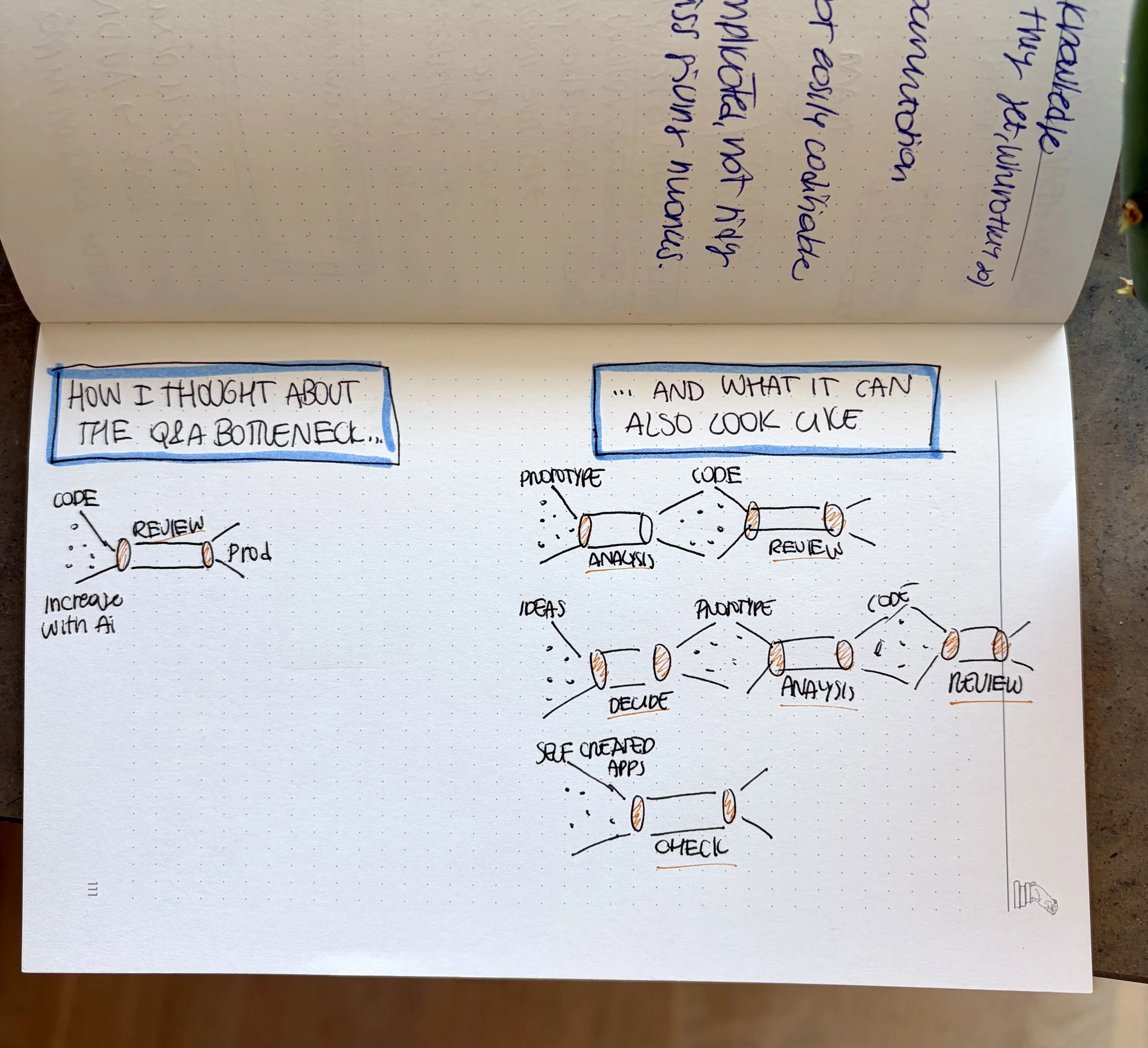
Birgitta also helped me see the "QA bottleneck" in a whole new light.
For a long time I believed that what we were referring to is the extra effort in reviewing the code created by the models. But there is more, what we are also referring to is the new system we need to put in place when we release new capabilities into the organization.
One example is by reviewing and evaluating the massive amount of prototypes we create, another example is monitoring how code get released when the release cycle is not only in the hands of engineers who have been trained in thinking about system and security.
What I take with me is that the "QA bottlenecks" are about quality. They might be on decision-making, priority, analysis, code review, or some place completely different. The bottleneck follows your organization, and how you set up the system. And they are definitely not only in the codebase.
Which brings me to my second takeaway...
The illusion of speed: or why structure matters more than ever with AI
Last year we started to talk about how the LLM models create the illusion of thinking (my post here). In short: the machines give you the illusion that they think with you, but they are not thinking (at least not yet).
What I take home after listening and discussing is that we're now experiencing another illusion, not in the models, but in how we use them. The illusion of speed.
The majority of AI-driven innovation is based on solving concrete problems (often internal ones), the majority of augmented teams are on the product-development side, with engineers, UX, and product managers focusing to solve a problem, and the ones that are leaning in the most are either (small) AI-native companies or the ones that fear disruption. And all of these user cases have one thing in common: they use AI for efficiency and speed.
We feel really fast, we seem to be speeding... but then we hit a wall.
The wall is our company systems, not just the tech, but how we operate, make decisions, and yes, document.
I was glad some talks addressed exactly this: how the hard work of understanding how we work together, how we document our knowledge, written and unwritten, and how we set up the system is what actually makes the difference.
The counter-intuitive lesson is that when everyone wants to speed, guardrails matter more than ever. The system sets the boundaries and it is stronger than the people inside it, incentives are what will drive quality (or lack of) and most importantly the people and companies who take the time to understand before execute, and learn as they go, will be the one who win.
One interesting thing is that this has nothing to do with AI per se. I listened to two talks about organizational coaching, and how to retain knowledge memory. They were explicit about not being AI-related, and yet they helped me think through the practices of team augmentation.
Building a learning culture is more important than ever, as the only lasting skill is unlearning
Structure and boundaries is what is needed to align, with or without AI
Autonomy = clarity of purpose, and especially with AI we should not take for granted that the purpose is clear
No decision or documentation structure = no augmentation as making implicit and explicit knowledge
Context is not alignment, the memory of individual and organizations is layered, messy, complicated, and we have not proven yet that AI can help when boundaries keep on shifting
The question I take with me: is augmentation possible when people collaborate on messy, unsaid, difficult to document questions? Or should we divide where AI can help (objective, data-based, well-documented decisions) vs when the subjective, messy, unsaid human nature should take front and center?
A (non AI) note on the hippo
In the midst of all the AI talk, I noticed a strange trend. The word mentioned almost as often as AI was....hippo (highest paid person opinion)
And I have to be completely honest: at first I cringed. I cringed because to me speaking about the hippo is completely missing the point as opinions are not worse (or better for that matter) based on your title.
This discussion reminded me of the narrative of founder mode that was so hyped one year ago. Then as now the reaction is to get protective, and miss out of really relevant, highly experience-driven insights.
First time I heard it I was annoyed, second time I raised by eyebrows, but the third I understood there was something else to dig deeper into. The "hippo talk" is probably a symptom that we still have way too many companies and digital products where decision making is not straightforward, and delegated not based on insights, but on status.
And that is the problem, especially because AI will amplify it, and amplify your bias. Which brings me to my last takeaway.
Ai is here, and it amplifies indiscriminately.
Ai is here, now what?! was the title of my keynote, and the conversations in and off stage added more layers in my thinking than the ones I had when arriving at the conference.
What is clear is that AI is here and raising expectations. We're all betting on a future where companies operate with AI at their center, and users expect fully enhanced AI experiences. The expectations are there, but who are the best ones at embracing them?
A rough list that I wrote down in my notebook. To lean into AI you need..
not a lot to lose
the willingness to disrupt yourself
the psychological safety to speak up, even when it is uncomfortable
understanding that working with humans is an asset, not something to automate away
the helicopter view to understand the system you operate in
the patience to document
the willingness to reinvent yourself
the bravery to let go of the identity you connect to your title
the guts to question if all of this is worth it, and take a stand
If there is one belief that got reinforced at this conference is thatAI is as much a human shift as it is a technological one, and it is precisely because of it that we all need different things to embrace it successfully.
If you ask me the receipt for success is a mix of curiosity paired with intentionality, depth, and leaning into the human friction to create alignment.
But, what I also take with me is that to navigate this, we need to see all the different facets of the problem. I can only see the world from my eyes, and that doesn't get me closer to an objective picture. As one attendee brilliantly put it: I found myself nodding along to your keynote, and this never happens. Which contrarian views do you follow to keep your view of the world updated?
Great question, and touché. I read many things, I speak with many people, but I am also guilty of filtering. Especially things I get annoyed by, but maybe to keep my curiosity up, I should start a new practice and filter more of what is similar and less of what annoys me.
This is maybe the biggest action I take home.
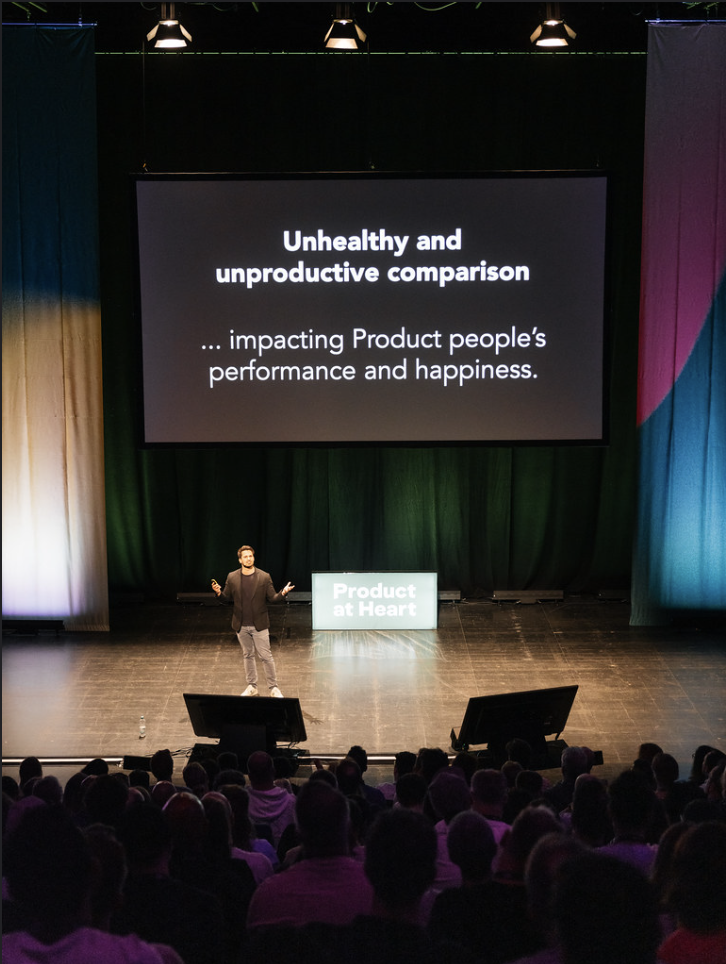

This year I had the pleasure of being at Agile on the Beach as a keynote speaker, and as an attendee, this is what I take home with me.