My main takeaways from Play to win, and why most strategies fail before they start
Strategy =
a set of choices that will deliver the best user value in a distinctive way, done in cooperation with your org to capture your collective wisdom.
Choose where to play, decide how to win. Easy peasy right?
Not quite, as everyone working with strategy knows all too well that what sounds like a straightforward approach has more than one thing that makes it complicated. From my experience:
Choosing what is important can get really complex when you want to do too much and different interests pull the company in different directions.
Company processes, and culture can hinder your choices.
The risk of choosing overpowers you and, pivots are too slow and companies disappear as the result.
Different perspectives or healthy tensions are not valued, and strategies become an exercise in compliance, with no real grip or differentiation.
Looking at the list you have it all: business acumen, relationships, change management, risk taking, empathy, and you have them all at the same time.
If it feels like it is a lot, it's because it is.
But complexity is also what makes strategy fun, and one of the reasons why I often go look for books to get a glimpse at how others solve strategic challenges. This is how I found Play to Win, one of the best strategy books I have read. It's grounded in real case stories, and written by executives that have lived through them.
Some of the stories read like a thriller — I found myself thinking "what happened, how will they solve this, oooh interesting turn". If you want a deeper understanding of how one of the biggest conglomerates in the world does strategy, read the book.
If you want a taste first, here are my main takeaways:
Strategy is about making choices, and making choices is hard
The book starts with framing the concept of strategy as a choice.
Strategy is an integrated set of choices that uniquely positions the firm in its industry so as to create sustainable advantage and superior value relative to the competition.
The authors propose a 5-step model to choose a winning opportunity:
what is your winning aspiration?
in which field are you playing ?
how will you win?
what capabilities do you need to win?
what management system is required?
All of this is described in the first 15 pages, and if it feels the authors are giving away too much too soon, I'll give you a spoiler: the hard part of strategy is not the framework, it's how to make the choices, and making them to win.
The big reveal: to have a good strategy you need to choose.
It sounds so straightforward, but reality hits when choosing means saying no to good opportunities, feeling the heat rising because all your eggs are in the same basket.
What I found interesting is how the different roadblocks on making winning choices are described in details:
Hiding behind goals instead of choosing
Thinking that strategy is only the C-levels job, when instead is part of everyone's job. (What changes are the scope of the choices, and the nature of the constraints)
Not understanding consumers enough to be able to make the best winning choices
Underestimating the importance of capabilities and system that bring the strategy to the entire company, and make it alive
I can totally relate. Making choices is hard, not because leaders can't, but because they want to keep options open. It's human nature to spread risk. But in most cases, keeping options open means dispersing resources and failing to create competitive advantage.
The golden rule that comes from the book is that focus is a key strategic trait, a muscle that should be trained and treated as a core company capability. Pair it with listening to signals to adapt, and a system you adjust during the course, and you are giving yourself the best possibilities to succeed.
You're in it to win, or just don't play
Strategy is about choosing, ok, but how do you choose the best opportunities?
The title of the book is clear: play to win.
Let's stop here for one second, as some might react to the concept of playing to win: can't you just be ok with being second, playing the underdog?
According to the book, the harsh answer to that question is: no. You need to have a winning aspiration for your playing field and your customers. If you don't, you are doomed to fail. Why? So many companies already try to win and they can't, imagine what is the likelihood of winning if you do not even try.
This point could be perceived as controversial, but I have seen it in different org where the whole strategy was to take some market share and being happy in becoming second. It sounded like a safe underdog strategy. What happened in practice was that the product just followed the best in class because you needed the "hygiene factors to win customers over", we had a strategy built on best practices, and never really took the time to understand what the organization existed to do, or for exactly whom.
And here comes the second key component: to win, there is no other way than starting and knowing your customers.
No matter the stage of your company or product, having a crystal clear vision of who you are serving and how is the non-negotiable start.
New product? Need to know what is the superior value you are creating and how, especially considering that there are only 2 ways of winning consumers over: either you are the best, or you are the cheapest.
Established product? Finding new segments, needs, and markets is most likely your best way of boosting growth.
The authors repeat the concept of customer-centricity over and over, to the point that it can feel sometimes like an overkill. C'mon doesn't everyone know it by now? Reality is probably that the majority of companies do not operate that way, and have a strategic stance that starts from the inside, instead of the outside.
How to create a winning strategy
If I had to summarize the step by step approach that is in the book, I would say:
Strategy is about making winning choices.
To make winning choices you need to start from the consumers.
To win the consumers there are only 2 ways: offer the best service, or the cheapest one.
Superior capabilities (like brand trust, distribution or scale) can be your true differentiator.
Read that list again, it feels quite simple, doesn't it?
And it also feels so intuitively right.
Let's stress test it against the current rise of AI-native technologies.
The ones who seem to be winning now are the ones who have identified a really specific target group and solve the problem better for them (i.e. Claude with privacy to win enterprise customers), the one who have superior distribution, or the ones who have been able to reinvest their margins into competitive advantage (Google).
Even before the AI era, the authors in the book were super clear: technology alone is not a differentiator, as competition will follow it, and sometimes will surpass the first mover. You need clarity on your moves beyond the tech, and here is how you create it:
1- Decide your playing field
Start from your customers -> decide how you are winning them over (are you the best or the cheapest?) -> keep your focus
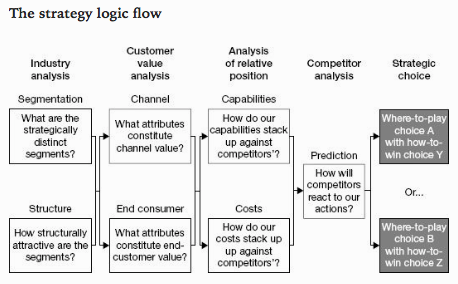
To define your playing field start from your industry, customers, relative position, and competition. Below you can find the "strategic logic flow" that the authors give as a blueprint to define your playing field.
2- Create supporting choices
Once you have your "where to play" you need to be extremely clear with your "how to win" choices, and make them easily understandable by all the people in your org.
Write them down, understand the tradeoffs, debate and land on what is helping you to win.
3- Understand your capabilities
You know where to play, you know how to play, but can you play?
The next, and sometimes underestimated piece of a winning strategy is defining the organization core capabilities, the ones that can bring the where to play and how to win choices together.
I've witnessed so many times strategies that were built on ambitions or wishful thinking and never really took into consideration what could actually get done, so again, if this feel like a "duh, of course moment" think back at your experiences and analyse when capabilities were really put at the center of your org strategic choices.
Core capabilities can take the shape of a superior understanding of the consumers, a capacity to build brands, a partnering network, or an innovation ability at scale. Those are the things that a competitor would not be able to replicate, even if they wanted, as it would cost too much money and time. When building a strategy you need to consider these capabilities, and reconsider the where to play and how to win if you do not have the capabilities to meet them.
To make sure you have the right ones, you can do a mapping and stress testing feasibility, distinctiveness, and defensibility.
4- Make sure you review your choices
So you managed to create a strategy that identifies your playing field, how you are going to win, and how your distinctive capabilities will help you. Now you are done....or?
Not quite, as things can go completely south if you do not have a system in place to make sure to follow and manage all your choices.
To have a strategy that is not only a deck fixed in time, you need clear assumptions defined, guardrails, triggers to act and adapt, and maybe most importantly a huge amount of buy-in to make it happen.
Which brings me to one of my biggest takes on the book…
The co-creation framework: how to make choices together to create buy-in
So many times when I have been working with strategy, I noticed a pattern.
A small group of people were really invested in it: they spent time, researched, debated. The group was kept by design cross functional and small, to get things done.
This "strategy group" then presented all their hard work to a broader group, the idea was to get input, but the real mindset was to convince this broader group that the strategy was the correct one. Since the goal was to create buy in, few questions were asked, compromises instead of real hard choices were made, and creativity and too big of a deviation from the plan was discouraged.
The result? An adjusted, full of compromise, strategy, not a better one.
Do you recognize this pattern? I am for sure guilty of having acted this way, and it took me quite a while to realize that my role working with the strategy was not to create a plan and then convince others of it. It was to co-create the strategy with them.
The difference might sound subtle but is substantial. It is about going from a mindset of "this is the plan, what do you think" to "these are our thoughts, what are we missing?". From advocacy to inquiry. From some weak compromises, to finding the strongest option together
The hard lesson behind it is that relationships and co-creation matter in a strategy, and if you ask me they are the defining factor to make or break it. Without it, you'll have a nice plan, with no passion behind it.
The book gave me inspiration and I have been using this method in several strategy sessions and I can assure that a small change in mindset, expectations, and questions makes a huge amount of difference when it comes to how much people feel they have contributed, and how much they believe in it. You can see below a sketch of the process I use.

I once had the chairman of the board telling me "I really like this process, I felt we looked at all the angles, and everyone contributed". And that was exactly the point.
If you feel it is your strategy you can explain it, you understand the tradeoffs, you'll communicate it with intent, and most importantly you will have all the incentives to want to get it done.
I know what you are thinking..isn't this going to take longer?
To which I would answer: it depends what you measure.
Yes, the "time to strategy" will get longer, as it will require deep debates and involvement, but the "time to value" will shorten, as everyone will row in the same direction. Because you involved, listened, surfaced fears and addressed them, because you gave everyone skin in the game.
Do the leap from convincing to co-creating, and let me know how it goes.
A cheat sheet for good strategy
There is no perfect strategy, no one size fits all, and as usual in business "it depends", but with all that said, the authors give some signs you can analyse and think about to stress test your strategy
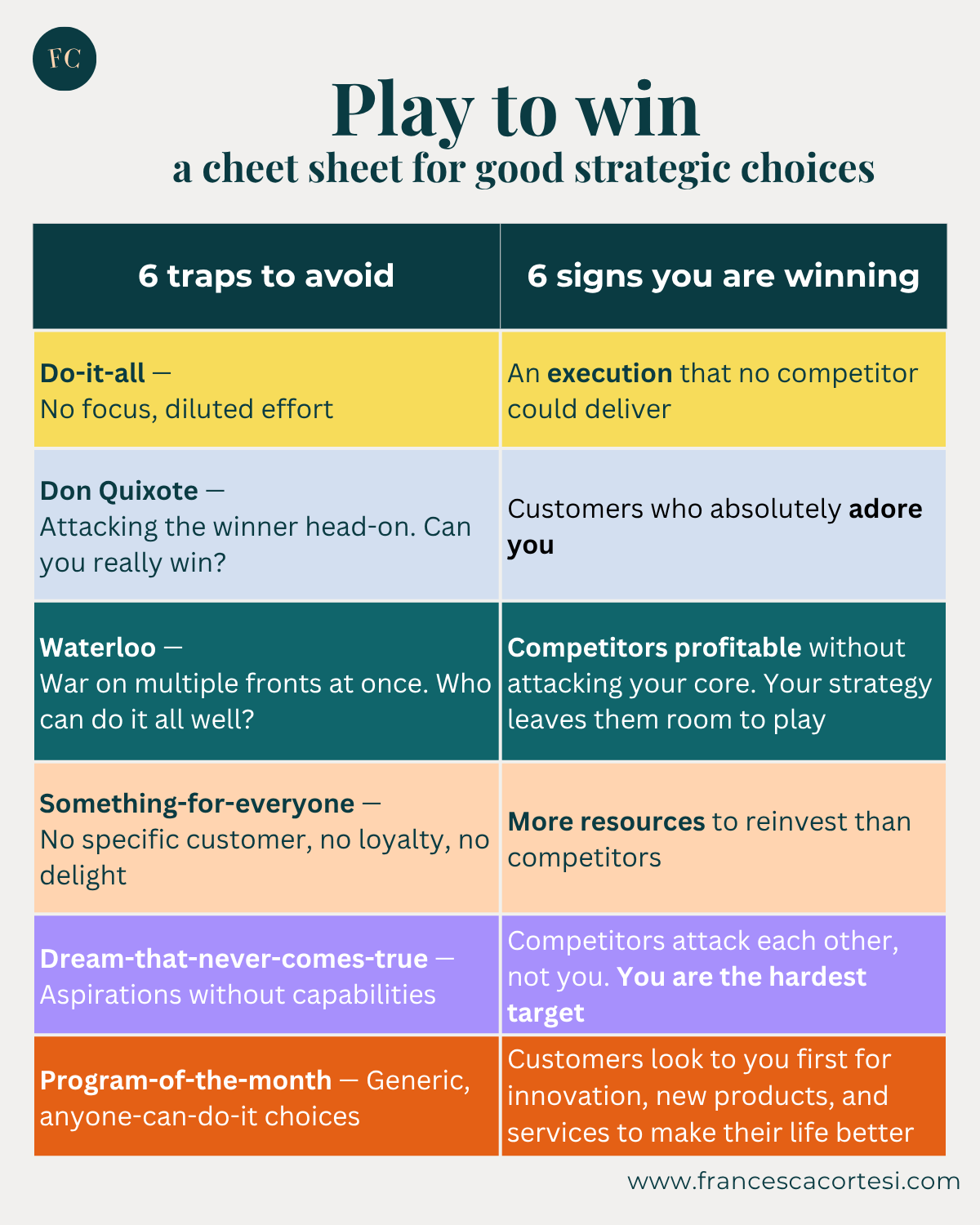
In my career I've seen many flavors of strategies, and the best ones were the ones grounded in customer insights, market knowledge AND company capabilities. I don't believe in blueprints, every choice is anchored in human factors like willingness to take risks or egos in the room. But this book is a good start to understand the dynamics that position you to win.
Now stop reading, start choosing your focus 🚀